winning
A generalization of factor multinomial probit models that scales to millions of variables
This package provides a novel fast algorithm for computing probabilities of contests where performances are correlated and margins (performance distributions) take almost any form. Moreover the inverse operation of calibrating location parameters is also handled, not to mention other computations useful for econometrics at scale (probit with millions of variables), rating systems, portfolio allocation and so forth.
The model, live
Six runners moved by two common luck factors; whichever draws the smallest performance wins. Drag each runner's ability and its two factor loadings, pick the noise distribution (and its skew), and the win probabilities update live. They are computed in your browser by the factor lattice algorithm this package ships, at verified parity with the Python. Runners loading the same factor with the same sign are teammates, opposite signs rivals; zero loadings recover the independent race, where Gumbel noise reproduces softmax exactly.
Quick start
from winning import race_probabilities, calibrate_abilities, removal_shares

p = race_probabilities(mu, V=V, D=D)     # all N shares, one field pass
mu_hat = calibrate_abilities(p, V=V, D=D)  # abilities back from shares
q = removal_shares(mu, V=V, D=D)         # P(j wins | i removed), all pairs
Max-wins semantics for the probit literature live in
winning.probit (shares,
calibrate_utilities, supplied-covariance fitting); the
density-agnostic research engine in winning.research; the
paper-faithful kernels in winning.factor.
Covariance grammars
Every grammar describes the same min-race
$Y = \mu + \text{noise}$; the grammars are declarative descriptions of the
noise covariance that admit $O(N)$-per-lattice-point evaluation. With the
normal base they are Gaussian covariance grammars; Independent
and Factor also accept any supported smooth base, while
Blocks, Nested and Tree are
Gaussian only. Pass any of them as structure= to the
front-door verbs.
from winning import (Independent, Factor, Blocks, Nested, Tree,
                     race_probabilities, polish_race)

tree = Tree.from_linkage(Z)                    # floored cophenetic correlation
race_probabilities(mu, structure=Factor(V, D))        # Σ = VV' + diag(D)
race_probabilities(mu, structure=Blocks(cluster, loading, D))
race_probabilities(mu, structure=Nested(cluster, loading, D, coupling, gamma))
race_probabilities(mu, structure=tree)
polish_race(p0=w, structure=tree, name_caps=0.05)     # nearest race under caps
Tree.from_linkage builds the race whose implied
correlation is the floored cophenetic correlation of a
hierarchical clustering (merge height maps through
$\rho=\max(1-2h^2,0)$; negative cophenetic correlation has no tree
representation). A
portfolio's HRP weights can therefore be inverted, re-priced and polished along the
dendrogram they came from.
Analytic fixed-grid Jacobians (rows sum to zero; off-diagonals are photo-finish tie densities) ship for the factor, block and nested grammars, with preconditioned Newton inversion throughout. An arbitrary dense $\Sigma$ is priced by fitting the grammar family (seriated blocks under global factors) and promoting the residual to extra factor dimensions. That is one seeded, reproducible call; it beats million-draw Monte Carlo on wall clock at $n = 2000$ and prices tail probabilities Monte Carlo cannot see.
Languages
The numpy implementation is the spec. The compiled kernels
(fastrace, thin
pyo3 bindings over the pure-rust
winning crate) accelerate every path: 232× on the classic
calibration, and input-bound to ten million runners on the block field. The
base-R package mirrors the complete API with no compiled dependency.
All
ports are parity-locked: parity/vectors.json embeds inputs and
outputs from the reference, and every language replays the same
twenty-two scenarios. Nineteen agree to within 1e-7 (most to 1e-10), and the
three fit- or optimizer-mediated ones to between 5e-4 and 5e-3.
pip install winning          # pure python (numpy/scipy)
pip install winning[fast]    # + compiled kernels (abi3 wheels)
pip install winning[certified]  # + winning.certified: Arb-ball enclosures (python-flint)
remotes::install_github("microprediction/winning", subdir = "r/winning")
Random test covariances come from randomcov: fifteen named ensembles. A random covariance matrix is defined only once its distribution is specified.
Papers
- Scalable inversion of contests with correlated
performances, including softmax and multinomial probit (2026,
arXiv:2609.01133,
SSRN working paper).
All shares of a correlated race in one O(QNL) pass,
graph-Laplacian derivatives applied matrix-free, and inversion
of observed shares back to utilities. Forward pricing is
benchmarked to ten million alternatives, and inversion to one
million. Softmax is the Gumbel special case of the same lattice.
Ships as
winning.factor; every experiment is a committed script underresearch/experiments/. Predecessor: the share-calibration draft. - Sampling-free
inference with win nodes in Bayes nets and correlated
bandits (2026, draft). When
the dependence among Gaussian variables runs through a few
shared factors, the probability that each variable is the
largest is computed deterministically, at a cost linear in the
number of variables at fixed factor rank and quadrature
resolution. The same computation gives the derivatives of these
probabilities and the likelihoods of an observed winner, a
quoted price and a published place. Under a posterior, the
probabilities are the action probabilities of Thompson
sampling. Experiments under
research/win_nodes/andresearch/rs_crn/. Supersedes the draft Deterministic probabilities for Thompson sampling and entropy search (first version September 1, 2026). - A posterior predictive
for pass@k (2026, note). An independent evaluation of the
published empirical-Bayes pass@k estimator on released rollout
records, under a design that genuinely extrapolates: two
training attempts per prompt, six held out. The plug-in
extrapolation understates aggregate pass@6 by seventeen points
and its impossibility verdicts are contradicted a third of the
time; shrinkage repairs most of the damage, posterior
integration a measured further step, and the threshold decision
a published diagnostic takes changes materially. Scripts and the
outcome table under
research/cavity_calculus/exp2_passk/. - Computation of collision local times: a connection between new scalable probit methodology and Atlas models (2026, research note). The derivative of a win probability is the accrual rate of a collision local time: for Brownian races the photo-finish flux at horizon s is the rate at which the leading pair's local time accumulates, verified against sixty thousand simulated paths, and computable at scale: a Russell-3000-sized field prices its full rank-1/2 collision-rate curve in under two seconds. Sketches market-implied index leakage (reconstitution turnover as rank-boundary local time) via a top-k flux formula, derived and not yet implemented.
- Think before rescaling probabilities to unity: evidence from thirty-nine tests of linear versus Gaussian renormalization (2026, SSRN 7745403). Rescaling a probability vector when an item is withdrawn, delisted or masked out of a softmax is one of the great unconscious modelling acts; it amounts to assuming a Gumbel race. Gaussian renormalization (re-running a Thurstone Case V contest among the survivors) is an equally canonical, tuning-free alternative. Scored out of sample, it has the lower held-out log loss in thirty of thirty-nine comparisons, re-litigating the constant-ratio rule against Case V with psychology's restriction experiments and new data.
- Rating Formula 1: a case for non-Gaussian noise in rating systems (2026). Seventy-five seasons of grands prix, a retirement-slab noise density, a qualifying control, and a stratified test against historical bookmaker odds.
- Inferring relative ability from winning probability (SIAM, 2021). The lattice algorithm this package grew from: recovering ability densities from a vector of win probabilities, as in pari-mutuel markets.
Older presentations
- Who ya gonna call? and How to respond to an RFQ: the same order statistic in trading, where the best response to a request for quote is a horse race entry.
Demos
- Watch it converge: choose a covariance ensemble and a field size. The lattice answers in milliseconds while frequency simulation converges at the inverse-square-root rate, live in the browser.
- Polish your portfolio: concentration caps without breaking model-consistency. The nearest race satisfying your limits is solved live in the browser with the analytic race Jacobian, showing the redistribution running along the correlation structure.
- Fit a correlated race: the inverse problem, live. Drag observed shares and a correlation, and the engine calibrates standalone abilities in the browser, against the naive independent fit.
- The photo-finish circuit: the race as a resistor network, computed live in your browser by the shipped algorithm. Click a runner to delete it and watch the share flow to factor-similar survivors, against the IIA prediction.
- race_field_demo.py: one shared survival field prices every competitor by division; the naive O(N²) route against the O(N) field.
- cavity_downdate_demo.py: the rank-one cavity twin, in which one inverse contains every leave-one-out inverse.
- js/factor: the calibration core in the browser, as dependency-free JavaScript checked against the Python (forward shares to ~1e-15, calibrated abilities to 2e-6); it powers the circuit demo above.
Heritage
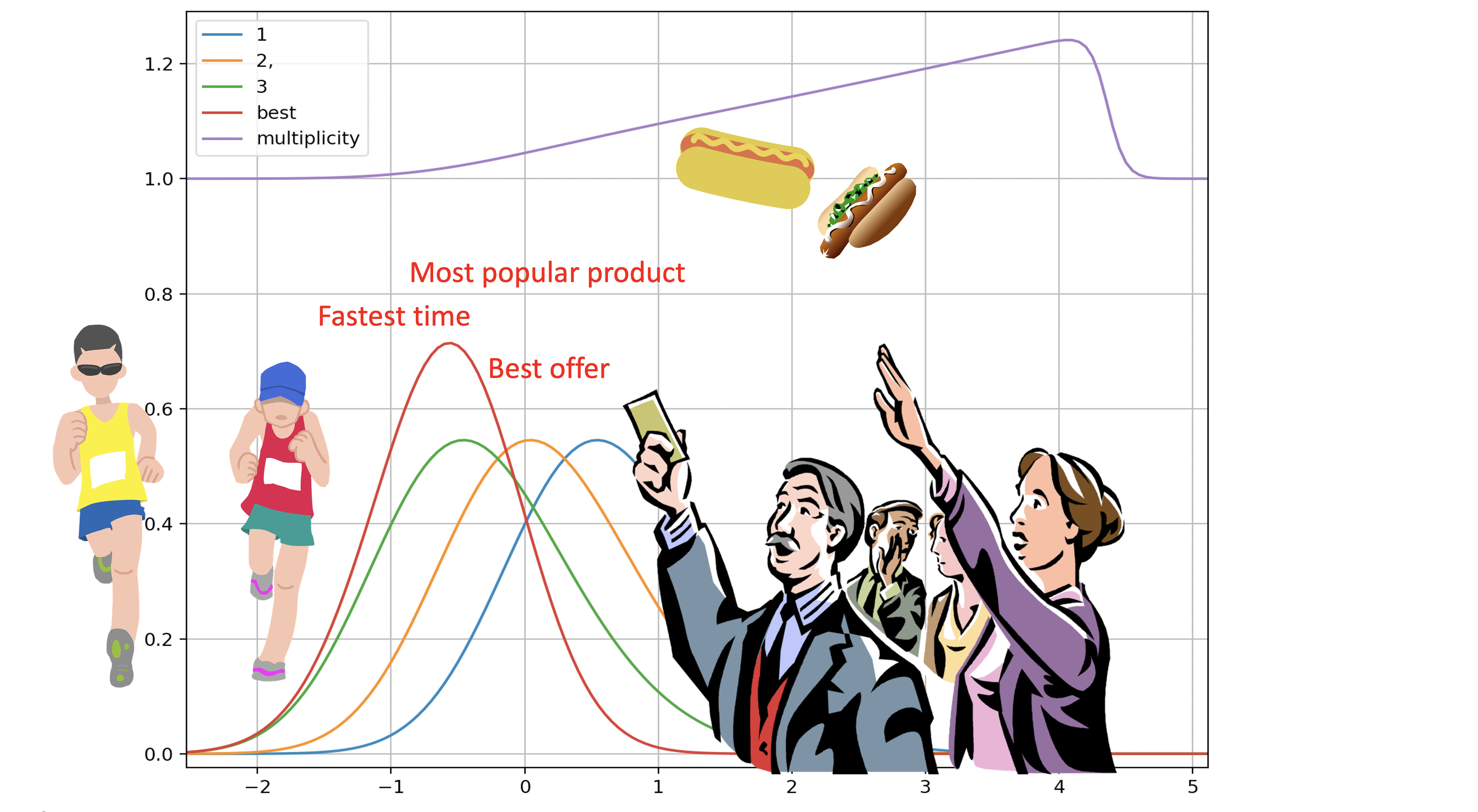
winning began as the reference implementation of the SIAM paper above.
By Peter Cotton, with sibling packages at
microprediction. The same
computation, inferring latent ability from who wins, has been
rediscovered field by field for a century, from Thurstone's 1927 law of
comparative judgment to language-model leaderboards:
the heritage, as a timeline →
Notes: disks do not fail independently: a common-cause factor in the public Backblaze data, and what it costs erasure-coding durability.
Get the source
github.com/microprediction/winning
·
pip install winning
·
Research scripts