winning
A generalization of factor multinomial probit models that scales to millions of variables
This package prices the winner of many: N competitors whose performances can be correlated through common factors, and for the independent and factor grammars can follow any smooth noise distribution (the block, nested and tree kernels are Gaussian, and say so rather than silently ignoring a base). One pass over a shared survival field gives all N win probabilities, and the same field answers removal and photo-finish queries; complete all-pairs tables of those have quadratic output size and are priced per query. Calibration runs in the other direction, from observed shares back to abilities. Factor probit, Luce's softmax and the finite-temperature softmin are special cases of one parameterized race.
The model, live
Six runners moved by two common luck factors; whichever draws the smallest performance wins. Drag each runner's ability and its two factor loadings, pick the noise distribution (and its skew), and the win probabilities update live — computed in your browser by the factor lattice algorithm this package ships, at verified parity with the Python. Runners loading the same factor with the same sign are teammates, opposite signs rivals; zero loadings recover the independent race, where Gumbel noise reproduces softmax exactly.
Quick start
from winning import race_probabilities, calibrate_abilities, removal_shares

p = race_probabilities(mu, V=V, D=D)     # all N shares, one field pass
mu_hat = calibrate_abilities(p, V=V, D=D)  # abilities back from shares
q = removal_shares(mu, V=V, D=D)         # P(j wins | i removed), all pairs
Max-wins semantics for the probit literature live in
winning.probit (shares,
calibrate_utilities, supplied-covariance fitting); the
retired density-agnostic research engine in winning.research; the
paper-faithful kernels in winning.factor.
One race, five covariance grammars
Every grammar describes the same min-race
$Y = \mu + \text{noise}$; the grammars are declarative descriptions of the
noise covariance that admit $O(N)$-per-lattice-point evaluation. With the
normal base they are Gaussian covariance grammars; Independent
and Factor also accept any supported smooth base, while
Blocks, Nested and Tree are
Gaussian only. Pass any of them as structure= to the
front-door verbs.
from winning import (Independent, Factor, Blocks, Nested, Tree,
                     race_probabilities, polish_race)

tree = Tree.from_linkage(Z)                    # floored cophenetic correlation
race_probabilities(mu, structure=Factor(V, D))        # Σ = VV' + diag(D)
race_probabilities(mu, structure=Blocks(cluster, loading, D))
race_probabilities(mu, structure=Nested(cluster, loading, D, coupling, gamma))
race_probabilities(mu, structure=tree)
polish_race(p0=w, structure=tree, name_caps=0.05)     # nearest race under caps
Tree.from_linkage builds the race whose implied
correlation is the floored cophenetic correlation of a
hierarchical clustering (merge height maps through
$\rho=\max(1-2h^2,0)$; negative cophenetic correlation has no tree
representation) — so a
portfolio's HRP weights can be inverted, re-priced and polished along the
dendrogram they came from. Analytic fixed-grid Jacobians (rows sum
to zero; off-diagonals are photo-finish tie densities) ship for the
factor, block and nested grammars, with preconditioned Newton
inversion throughout. An arbitrary dense $\Sigma$ is priced by
fitting the grammar family (seriated blocks under global factors)
and promoting the residual to extra factor dimensions — one seeded,
reproducible call that beats million-draw Monte Carlo on wall clock
at $n = 2000$ and prices tail probabilities Monte Carlo cannot
see.
Languages
The numpy implementation is the spec. The compiled kernels
(fastrace, thin
pyo3 bindings over the pure-rust
winning crate) accelerate every path — 232× on the classic
calibration, input-bound to ten million runners on the block field — and the
base-R package mirrors the complete API with no compiled dependency. All
ports are parity-locked: parity/vectors.json embeds inputs and
outputs from the reference, and every language replays the same
twenty-two scenarios — nineteen to within 1e-7 (most to 1e-10), the
three fit- or optimizer-mediated ones to between 5e-4 and 5e-3.
pip install winning          # pure python (numpy/scipy)
pip install winning[fast]    # + compiled kernels (abi3 wheels)
remotes::install_github("microprediction/winning", subdir = "r/winning")
Random test covariances come from randomcov: fifteen named ensembles, because “a random covariance matrix” means nothing until the measure is named.
Papers
- Scalable inversion of contests with correlated
performances, including softmax and multinomial probit (2026,
arXiv:2609.01133,
SSRN working paper).
All shares of a correlated race in one O(QNL) pass,
graph-Laplacian derivatives applied matrix-free, and inversion
of observed shares back to utilities — forward pricing
benchmarked to ten million alternatives, inversion to one
million. Softmax is the Gumbel special case of the same lattice.
Ships as
winning.factor; every experiment is a committed script underresearch/experiments/. Supersedes the earlier share-calibration draft. - Deterministic
probabilities for Thompson sampling and entropy search (2026, draft). The probability that an alternative
is truly best, declared intractable in reinforcement learning
and approximated there from marginal means and variances alone,
is a shared integral that quadrature evaluates in time linear in
the number of alternatives, at fixed factor rank and resolution,
whenever the posterior covariance is factor-plus-diagonal. Two
standard observation processes, common random numbers and
per-arm Gaussian observations, keep the posterior in that form
at every update. At a common nominal threshold, stopping on
this vector uses between a third and two-thirds of the
replicates of the marginal-only rules, and sampling from it
matches Thompson sampling's regret, as the occupancy identity
requires. Experiments under
research/rs_crn/. - A posterior predictive
for pass@k (2026, note). An independent evaluation of the
published empirical-Bayes pass@k estimator on released rollout
records, under a design that genuinely extrapolates: two
training attempts per prompt, six held out. The plug-in
extrapolation understates aggregate pass@6 by seventeen points
and its impossibility verdicts are contradicted a third of the
time; shrinkage repairs most of the damage, posterior
integration a measured further step, and the threshold decision
a published diagnostic takes changes materially. Scripts and the
outcome table under
research/cavity_calculus/exp2_passk/. - Computation of collision local times: a connection between new scalable probit methodology and Atlas models (2026, research note). The derivative of a win probability is the accrual rate of a collision local time: for Brownian races the photo-finish flux at horizon s is the rate at which the leading pair's local time accumulates, verified against sixty thousand simulated paths, and computable at scale — a Russell-3000-sized field prices its full rank-1/2 collision-rate curve in under two seconds. Sketches market-implied index leakage (reconstitution turnover as rank-boundary local time) via a top-k flux formula, derived and not yet implemented.
- Softmax masking is a choice model: the evidence for linear versus Gaussian renormalization of probability vectors (2026, provisional draft). When an outcome is withdrawn — scratched, delisted, or masked out of a softmax — proportional renormalization is the reflex and, in many models, the architecture. Psychology has tested it under restriction since 1957 as the constant-ratio rule; this study scores it out of sample against re-running the Gaussian contest among the survivors, over thirty-nine population comparisons. Gaussian renormalization has the lower held-out log loss in thirty, with the losses concentrated on one-dimensional, strongly confusable stimulus sets.
- Rating Formula 1: a case for non-Gaussian noise in rating systems (2026). Seventy-five seasons of grands prix, a retirement-slab noise density, a qualifying control, and a stratified test against historical bookmaker odds.
- Inferring relative ability from winning probability (SIAM, 2021). The lattice algorithm this package grew from: recovering ability densities from a vector of win probabilities, as in pari-mutuel markets.
Older presentations
- Who ya gonna call? and How to respond to an RFQ: the same order statistic in trading, where the best response to a request for quote is a horse race entry.
Demos
- Watch it converge — choose a covariance ensemble and a field size; the lattice answers in milliseconds while frequency simulation crawls its inverse-square-root slope, live in the browser.
- Polish your portfolio — concentration caps without breaking model-consistency: the nearest race satisfying your limits, solved live in the browser with the analytic race Jacobian, showing the redistribution running along the correlation structure.
- Fit a correlated race — the inverse problem, live: drag observed shares and a correlation, and the engine calibrates standalone abilities in the browser, against the naive independent fit.
- The photo-finish circuit — interactive: the race as a resistor network, computed live in your browser by the shipped algorithm. Click a runner to delete it and watch the share flow to factor-similar survivors, against the IIA prediction.
- race_field_demo.py — one shared survival field prices every competitor by division; the naive O(N²) route against the O(N) field.
- cavity_downdate_demo.py — the rank-one cavity twin: one inverse contains every leave-one-out inverse.
- js/factor — the calibration core in the browser: dependency-free JavaScript at machine-precision parity with the Python; it powers the circuit demo above.
Heritage
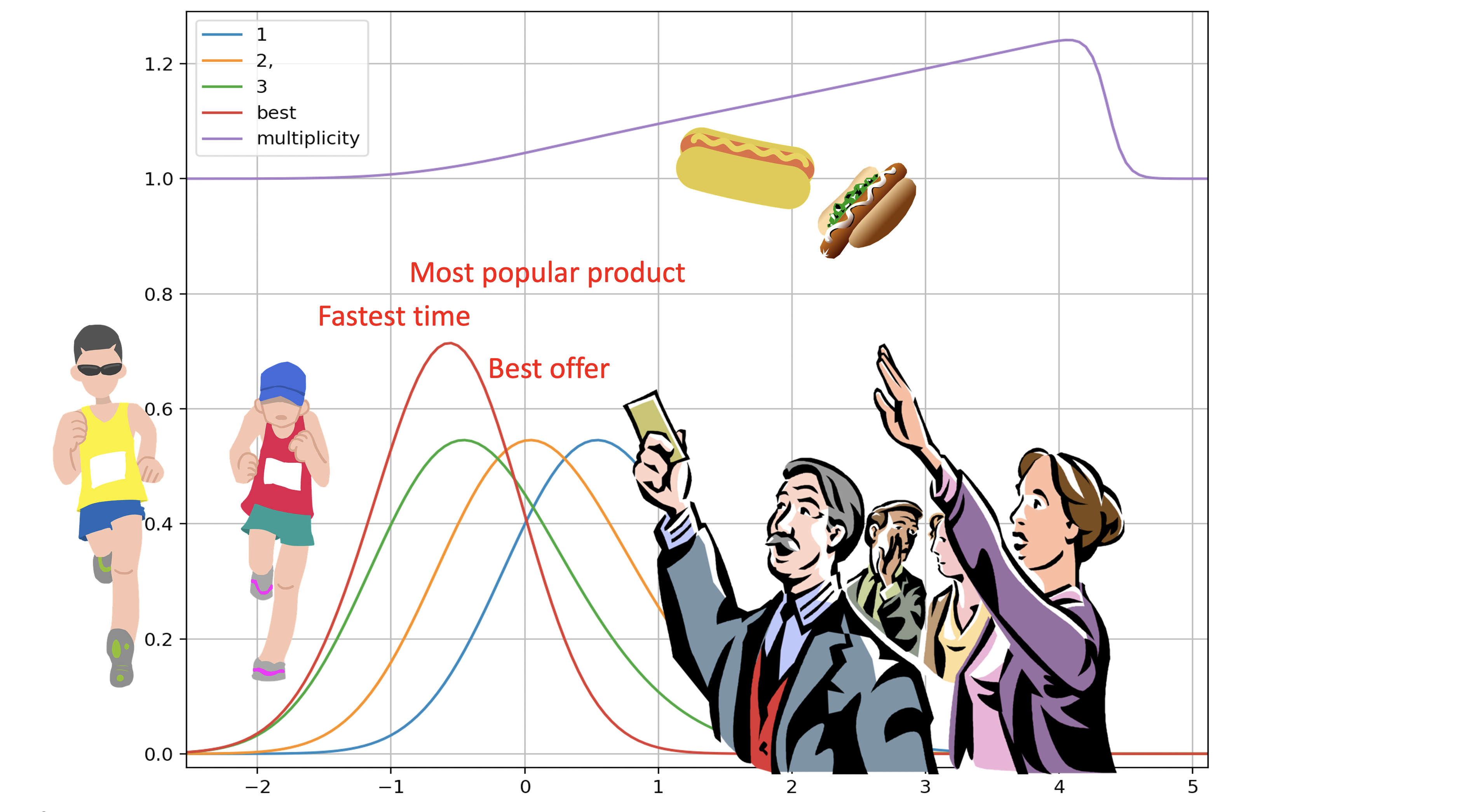
winning began as the reference implementation of the SIAM paper above.
By Peter Cotton, with sibling packages at
microprediction. The same
computation — inferring latent ability from who wins — has been
rediscovered field by field for a century, from Thurstone's 1927 law of
comparative judgment to language-model leaderboards:
the heritage, as a timeline →
Notes: disks do not fail independently — a common-cause factor in the public Backblaze data, and what it costs erasure-coding durability.
Get the source
github.com/microprediction/winning
·
pip install winning
·
Research scripts